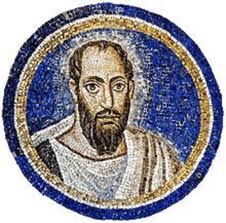
If we go out of the city of Rome by the gate near the English cemetary, with its many associations, we come eventually to the church of St. Paul Without the Walls, a costly structure, enormous and empty. The church is supposed to mark the site of Paul's tomb. Whether this is true of not, it does mark the attempt to entomb his spirit. On its wall Paul is described as DOCTOR GENTIUM, the theologian of the Gentiles. That inscription truthfully expresses the position which has been given to Paul by the Christian hierarchy. It has been maintained that primarily he was interested in subtle intellectual and philosophical distinctions, and that his letters set out a complicated theological scheme, the understanding of which is necessary to salvation. Bitter are the battles which have been fought over the meaning to be given to such words as justification, adoption, atonement, the last of which, by the way, is never used by Paul.
These subtleties of intellectualization have been discarded by many of us; to others they still have a vital meaning. I shall not discuss whether or not these concepts are correct. But to those of us who have thrown away our former theological notions I do say that in throwing them away we must not discard Paul and his message. Because, whatever the value of the theological ideas which have been erected on the alleged foundation of Paul's letters, I am very sure that he himself never entertained them nor any others like them. His method was quite different. Paul had seen himself, seen the hopeless mechanicality of his condition. He had also experienced the new birth, and found himself "in Christ" a new creature. This change of state was the only thing that Paul was interested in; it was to the new state that he wanted to draw his readers. He was a missionary, not a theologian.
In order to demonstrate that Paul's message was not doctrinal and theological, I purpose now to consider some of the words which Paul uses more or less frequently and which have been made the basis of complicated systems of which Paul himself had not the slightest conception. What I shall have to say is not a mere reflection of personal idiosyncracy but is based on conclusions which have been reached by scholars who have made a careful study of the papyri and contemporary monuments and inscriptions. For I think that a great part of the terrible error into which the church has fallen has been due to mistranslation. The early translators made the mistake of going to literary rather than vernacular sources for the meaning of Paul's words. For this reason I think that it is a good thing to use a good modern translation like Weymouth in conjunction with the Revised Version. In my quotations from the New Testament I use Weymouth or Moffatt or the Revised Version or sometimes my own translation, however the meaning might be best brought out.
Our next considerations will unfortunately but necessarily be somewhat negative in character. That is, we shall try to show what Paul did not say. Afterwards we shall approach the subject from a more positive angle. That is, we shall try to examine what he did mean by "being in Christ," by faith "in Christ," which after all is the sum total of his message.
The five words which I have selected for consideration are the following:
Redemption
Adoption
Justification
Reconciliation
Forgiveness.
Each of these words has been given a very formal, definite theological meaning. If we look at the Westminster catechism, we can find them all defined with scrupulous exactitude, and, I may add, with a signification which Paul never so much as hints at, a meaning which they could not possibly have borne to Paul or his readers. These words and perhaps some others have been called the Ladder of Salvation, Steps to Salvation. There have been serious diputes as to which of the processes was the highest, which was the most sacred, which came first, whether there could be forgiving without reconciliation, whether justification came after redemption. But as a matter of fact those distinctions never entered into Paul's mind at all. In his meaning and to the understanding of his readers, the five words were simply five pictures of the state of man before God; as a slave, as an adopted son, as an accused person, as a commercial debtor, as a rebellious and warring enemy. None of these words are technical theological terms. No one of them is a complete or adequate picture in itself, but taken together they give some idea of the state in which Paul found himself and of the change which had come over him.
Let us start with the first word, the word translated Redemption. This was probably the most vivid to Paul because he recurs to it most often. The Greek word means "liberation procured by the payment of a ransom." So "emancipation" is a better translation than "redemption." It was constantly used in connection with the purchase of a slave. There is in the word a clear allusion to the social system of slavery then existing. But after recognizing the true, contemporary usage and meaning of the word, Liddell & Scott, in their Greek Lexicon, add that in the New Testament it means "deliverance effected through the death of Christ from the retributive wrath of a holy God and the merited penalty of sin." This surprising addition finds no warrant in any of Paul's writings.
Let us examine his usage. We must remember that in the civilization of his time slavery was one of the most noticeable and characteristic institutions. A picture drawn from slavery must have been peculiarly vivid and appealing to the classes of society from whose ranks the early Christians were largely recruited. And particularly liberation, emancipation, was the idea that was constantly in the slave's mind. In fact it has been said that Christianity made the headway it did because it made just such an appeal to the slave class. However that may be, we find Paul reverting to the subject again and again. Our very epistle begins, "Paul, a slave of Jesus Christ." This gives a clue to what redemption, liberation meant to Paul and his readers. It was the emancipation of the slave, or a change of ownership from sin to God. This is brought out very clearly in the sixth chapter of the Epistle to the Romans, verse 6:
"Our old self is nailed to the cross with him, so that we no longer shall be slaves of sin."
Verse 14:
"For sin shall not be master over you."
Here Paul uses the correlative word, the "master" of the slave.
Verse 16:
"Do you not know that if you put yourself at the disposal of anyone as slaves to obey, you are his slaves whom you obey."
The word which I translated as "put yourself at his disposal" is the very same word that Paul uses where he speaks of "presenting your bodies as a living sacrifice." And there is a very good reason presented here why that other presentation should be made. You present your bodies to God and no longer are the slaves of sin. This is your normal life, says Paul. It doesn't sound much like purchasing deliverance from the retributive wrath of an angry God. Then he goes on with his figure, in the same verse:
"You are the slaves of him whom you obey, whether it be slaves of sin, which leads to death, or slaves of duty, which leads to righteousness."
That word "duty" or "obedience" as it might be translated, has some interest to Friends. It is the noun form of the verb "to listen," with an intensive particle. Literally it means "listening beneath." The word was used in common speech, of attending a door—the work of the porter in answering the knock. So with Paul obedience is lstening, listening to objective conscience, listening to the inward voice, listening for the Spirit, to let him in.
Verse 17:
"And although once you were the slaves of sin, you have now given your obedience to the new pattern of teaching."
There the word is "listening" again. YOu have hearkened unto it.
Verse 18:
"Being liberated from sin you become slaves of righteousness."
And in the next verse, verse 19, Paul plainly states what he is doing, that is, speaking pictorially not theologically. He says:
"I speak after the manner of human life (that is, I draw a metaphor from human affairs). As you once presented your faculties as slaves to impurity and lawlessness, so now you must present them as slaves to righteousness, unto sanctification (that is, to the degree of setting apart)."
That is all "sanctification" means. It means the same thing as "presenting your bodies a living sacrifice," entire devotion, a complete change of centre of gravity.
Verses 20 and 22:
"For while you were slaves of sin you were free as to righteousness. But now liberated from sin and enslaved to God, you have your reward."1
I do not think there can be any doubt about what Paul meant by that word "redemption"—"liberation." He says himself that he is speaking in a metaphor, a human picture. Why doubt it?
How vividly he himself felt the force of his own picture is shown by the fact that he represents the Incarnation as being basically a taking on of slavery. In Philippians, Ch. 2, verse 7, he speaks of Jesus taking on the form of a slave and being born in the likeness of men. That is what it means to be a man,—a slave. That is how Paul had seen himself. Jesus said the same thing of himself. Mark 10:45: "He who would be first must be the slave of all. The son of man came not to be served but to serve and to give his psyche as a ransom for many." That is where the purchase price came in.
Paul even applies the metaphor of slavery to Creation. In the 8th chapter of Romans, verse 20, he says:
"Creation was made subject to futility, that creation itself might be freed from the slavery of decay into the liberty of the glory of the sons of God."
Now we must not think that Paul invented this metaphor. He had plenty of precedent for using it in religious exposition. The Psalmist said (Ps. 116:16) "O Lord, I am thy slave, I am thy slave and the son of thy slave woman." It came to Paul, not only from what he saw in contemporary Greek life, but from his Jewish training. Many of the old Hebrew names have this figure in them. "Obededom" means slave of Edom. "Abdiel" is the slave of God. "Abdullah" is the same word. "Obediah" is the slave of Jehovah. The root that means slave is "obed." To me it is very striking that we find it in our word "obedience," although that word does not come from the Hebrew at all. It comes from the Latin and means "listening" like the Greek, but it appears to have the same root as the Hebrew. To the Jew it must seem to mean "slave obedience."
It was not only the Hebrew religion but the Greek religion also used this figure of slavery. They employed constantly the expression "slave of God." In the Metamorphoses of Apuleius, Isis is represented as saying to a new convert, "You will remember clearly and keep laid up in your inmost mind that the remaining course of your life, to the very end of your last breath, is mortgaged to me."
This brings us to consider a phase of the institution of slavery that made Paul's figure of emancipation especially pointed. It appears from the inscriptions that when a slave was to be liberated, it was the custom to deposit the purchase price in the temple of a god. When the time of emancipation came the money was paid to the master by the god and in form the slave was transferred in ownership from the master to the god; and therefore he was the slave of the god, but free as to other men. This was a very well-known custom, often referred to. So, when Paul used the expressions "emancipation" and "slave of God," you can see how vivid the expression must have been to his hearers.
There is one other thing that indicates that this is what Paul had in mind. When the slave became the slave of the god, he was branded as such; and you will remember that in Galatians Paul says, "I bear in my body the stigmata of Christ,"—the branding marks of Christ. He was simply carrying the figure a little further.
Now let us look at our second word, Adoption.
The Greek word is not found in classical authors at all. It has been thought that Paul invented it to represent theologically the very close special relation of God to the convert. The word is used in Romans, Chapter 9, 4th verse, where he speaks of Israel as having the "adoption"; and so Liddell & Scott define the word as "That relationship which God was pleased to establish between himself and Israel in preference to all other nations." But the word has no such special origin. It is the technical law term for the adoption of a son. While it is not found in classical authors, it is not peculiar to Paul, because it is found very often in inscriptions on monuments to indicate legal adoption.
It is not hard to see Paul's meaning. He was not entirely satisfied with his metaphor of the freed slave of sin becoming the slave of God. He said he was speaking in human fashion when he said that. But the new relationship was something different to him. To be sure, in antiquity, the slave when liberated became the slave of the god: but that was not the case with Paul's God. When He freed from slavery to sin the individual was adopted by Him as His son; he did not become His slave.
Romans, 8:14:
"For as many as are led by the spirit of God are children of God. For after your conversion you received not the spirit of slavery again—"
Note the use of the word "again." It is not just a new slavery that you are taking on, but
"you received the spirit of adoption, whereby we cry, Abba, Father."
In verse twenty-three he speaks of those who have the first fruits of the spirit as waiting for the adoption, namely, the emancipation or redemption of the flesh. In other words there is not any question which comes first, adoption or redemption. They are one and the same thing in different aspects. Adoption is simply Paul's erratum on his metaphor of the freed slave. There is no use trying to find the subtle, theological distinction between redemption and adoption,—that is, if we are going to stay within the thought of Paul. They are simply the two pictures of the freed slave and the adopted son. But what a light those pictures throw on what must have been Paul's experience!
Now, that word Justification. That probably is more talked about in connection with Paul than any other word. And it is a very curious thing, Paul only uses the word three times in all his letters, and even then he uses two different Greek words. While the noun is rare, the verb occurs frequently, "to justify," as we translate it, and as a boy I often wondered what "to justify" meant. Well, in classical times it never meant to make right, to make good, to make just; but it was another law term, meaning "to acquit,"—nothing else, and I do not believe Paul ever tried to use it in any other sense.
The old picture of the Day of Judgment was well known in Hebrew religion, and the picture here is of man the accused before God, and God acquits him. The three places where the noun is found are as follows:
Romans, 4:25:
"He was raised for our acquittal."
Romans, 5:16:
"The judgment coming from one sin was condemnation, but the free gift even after many sins was acquittal."
Romans, 5:18:
"One sin brought condemnation, but one act of righteousness brought acquittal."
The meaning of the word in the first passage is not necessarily "acquittal," but all doubt is resolved by the two passages quoted from the fifth chapter where Paul is most explicit. The first eleven verses of Chapter 5 are really a commentary on the fourth chapter. For instance "raised for our acquittal" does not mean that the fact of the resurrection effects the acquittal. It means that Christ was raised to life that we might share in that life and thereby be acquitted. This is made clear by Chapter 5, verse 10:
"For if while we were enemies we were reconciled to God through the death of His Son, much more shall we be saved in his life."
In painting his picture of the accused person, Paul uses the term "condemnation" as well as "acquittal," as the following passages show:
Romans 8:1
"There is therefore2 no condemnation for those who are in Christ Jesus."
Verse 33:
"Who shall bring a charge? It is God who acquits.
Who shall condemn?"
This acquittal of Paul's is through faith. But it is not a reward for faith. You will understand that if the latter were true, then faith would be a form of works. It would be something that we do to win acquittal. But that is not Paul's view. When we think that, with him, faith is not something to be done, was not a form of belief, but was a peculiarly close blood-relationship with Christ, then we see what faith in Christ or in his blood means.
The other words are Reconciliation and Forgiveness. I shall be briefer with them.
Reconciliation. Here the picture is of man as an enemy of God, who becomes reconciled to him, at peace with him, no more at war with him. Nowhere is it ever said that God is reconciled to us. We are the rebellious ones, we are the warring ones, we are the ones who are reconciled through Christ. This figure ought to be particularly interesting to Friends, because Reconciliation, in Paul's usage, is nothing but stopping the state of war with God and coming to peace with Him.
Paul makes his meaning very clear, Romans, Chapter 5, verse 10:
"While we were enemies we were reconciled to God."
The first verse of Chapter 5 says:
"Being justified (that is, acquitted) by faith, we have peace with God through our Lord Jesus Christ."
And then in the eleventh verse he says, "Through whom we have now received the reconciliation." So that you can see that Paul has no technical meaning for Justification and Reconciliation. He uses the terms interchangeably—simply two different pictures of his new state.
Forgiveness. Here the man is a debtor. The idea of sin as a debt is a very old one, very common in Hebrew religion, perhaps because of their commercial instincts. In the Lord's prayer it is said, "Forgive us our debts." You remember, too, that passage in the Epistle to the Philippians, where Paul uses technical commercial terms playfully to indicate that the Philippians had paid their debt to him. Paul often uses this expression, but there is an especially vivid picture in Colossians, Chapter 2, verses 13, 14:
"You were dead in sins and he has given you life, forgiving your sins. The bond which was in force against us he blotted out and cancelled, nailing it to the cross."
That cannot be anything but a metaphorical use, and I am sure that primarily this is what Paul meant by forgiveness: Our debt is cancelled.
And so we lose many theological ideas but we get a picture of Paul, the liberated slave, the adopted son, the acquitted prisoner, the enemy brought to peace, the forgiven debtor, and that is what Paul wanted.
In closing, I think I ought to explain why, after saying such hard things about words and verbalization, I have given up so much time to just the discussion of words. It is because here we have a good example of the right use of words and of the right way, and the wrong way, to receive them. Words are not to be condemned, but our abuse and misuse of words. We try to make a distinction between words which are abstract or empty and words which are concrete and form a picture. Here are five words, all of them pictures, and yet they seem to be abstract. But it is we ourselves who have made the abstraction. They were not abstractions to Paul, but we have made the mistake of taking the words, not as we should, simply as sign-posts pointing to reality, but as having some virtue in themselves. Therefore, we give abstract meanings to Justification, Redemption, Adoption. We abstract their meaning. But if we come to look at them, we find they had a very lively meaning, that they are actual pictures. Considering Adoption as the special relationship that God had with Isreael, can mean nothing to us. We are lost, we flounder about, when we try to consider such a thing. But when we consider that we are no longer slaves, but sons, that means something to us, and we see the sort of thing Paul had in mind. He did not present his words as having any virtue in themselves, but you may be sure that every time he used a word it had some living experience behind it. And if we look at the words, not as a magical or logical formulae, but as a sign-post to experience, we find that experience.
There is a very fundamental truth behind all this. To quote Quaker Pennington again: "The end of words is to bring men to a knowledge of things beyond what words can utter." Again he says, "All Truth is a shadow except the last. But every Truth is substance in its own place though it be but a shadow in another place. And the shadow is a true shadow as the substance is a true substance." We must conceive of a truth or a thought as a substantial form. It is just as substantial as a table but of a different order of substance. It is just as much of a reality as is God's love, and quite as inexpressible in words. Words can be considered then as the shadow of that substantial form, outlining it and indicating its presence, but never in any real sense reptresenting or expressing it. Shelley puts this idea in poetical form:
"Language is a perpetual orphic song
Which rules with daedal harmony a throng
Of thoughts and forms, which else senseless and shapeless were."
Without words we might not know of the existence of a thought, but even when words are used we are no better off unless we win past them and reach the thought beyond. If we stop and play with the words we are prostituting their function. We have mistaken the shadow for the substance. Of the words which come from Life we have gathered death. The letter killeth but the Spirit giveth life.
There is another way of putting it. Words are to the living thought as the body of flesh is to the soul or real self. Behaviorists are fond of saying that our bodies are machines. This is true. Paul knew that his body was acting mechanically and not in accordance with his will. But Paul knew and we know that all has not been said when we call our bodies machines. They are a special type of machine, known as an organism. An organism has behind the machine an integrating principle which is called Life. In Man, the principle behind the machine we call the self or the soul. It is that which gives the activity of the organism meaning. You will remember that I said the words of Paul partook of the nature of an organism. Now you can see the significance of that statement. When we recognize the body as an organism we know that we cannot exhaust its meaning by considering it simply by itself, weighing its atoms, classifying its properties, cataloguing its forms of behaviour and so on. Instead we look for the individuality behind the body. It is the same with Paul's words. As they are an organism their significance is not in themselves but in the integrating principle behind them, the living thought of which they are the body. If we take them merely as verbalizations, it is like taking a man as so much meat, so much chemical substance. We sometimes do that, as when we consider a man as a unit of labour. That is taking the letter for the Spirit.
1Close quote missing in PtS-32.
2Spelled "therefor" in PtS-32.