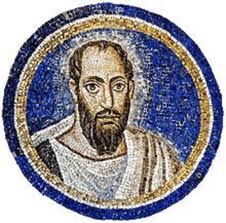
We have been examining the sociological background of Paul's writings not because such matters explain his message or account in any way for the motivation or method of his letters. On the contrary, these are things which we must know about Paul only to be able to sweep them away and get at the real Paul underneath. On account of his Hebrew environment Paul's letters are full of Rabbinical illustrations and arguments. But in spite of that Paul's conclusions and underlying thought are the very antithesis of the Jewish psyche. So far was he from the Jewish idea of law, for instance, that he has even been accused of antinominalism. It is the same way with the Greek influence. Paul was very sensitive to the life around him and quickly absorbed and used the Greek elements with which he was familiar. Gilbert Murray calls him one of the greatest Greek writers. I think myself that he is one of the greatest writers in any language. But, although he was a great Greek writer, he was entirely un-pagan, entirely un-classical in his viewpoint, in his methods, in every way. If we must pigeonhole Paul he was emotionally closer to the mystics of the Middle Ages than he was to any classical writer. He did not have that idea of Fate—Anangke, Moira, Aisa—always enigmatic, inexplicable, that the Greeks had constantly pursuing them, although in the doctrine of predestination something of the sort has been read into Paul. But Paul was not a predestinarian; he was a universalist, if he was anything. Likwise, when we say that Paul used the vernacular tongue rather than a literary style or vocabulary, we haven't really explained anything. For Paul, after all, was not talking like "the man in the street." Far from it. There was a vast difference in his subject-matter, the scope of this thought. It is one thing to use words of common speech for ordinary social intercourse, and quite another thing to use them, as Paul did, with deliberate intent,—to indicate spiritual or objective truths quite apart from the aims of ordinary planetary existence.
So the source of Paul's gospel, its meaning and method, are to be found not in his sociological training or environment, but in an individual experience which was quite apart from these things. The nature of that experience (I am quite unwilling to call it a spiritual experience, and let it go at that) we must try to understand, for Paul in his letters is not theorizing or speculating or arguing, but merely trying vehemently, almost incoherently sometimes, to make that experience so vivid to his readers that they will be moved to enter upon it for themselves. In so doing he summoned to the aid of his rich intellectual and emotional nature every resource afforded him by both his Jewish and Greek training. He used the common language of the people and the details of every phase of the actual life about him as media with which to paint the picture of what he had seen and felt, the mystery which had been revealed to him he calls it.
Jesus used the same method. In the Sermon on the Mount, for instance, he constantly used the comon things of everyday life to give meaning to what he said. The likeness goes deeper. You know Paul said he had the mind of Christ; at least that is what he aimed at. Now Jesus never wrote a book. He was only incidentally a teacher. First and foremost He was a Life. It is evident from his recorded sayings that what he said was not for the sake of inculcating a doctrine, but in order to explain that life to his followers. Paul's teaching was similarly motivated. His whole life to him was nothing more than the shifting of the centre of gravity from "Adam" to "Christ," if I may be permitted for the time being to use Paul's own technical terms without explanation. He who had been the slave of his planetary organism, suddenly learned his functional post in God's scheme and how to fill it. His letters have the sole purpose of making that life experience available to others.
The basis of every one of his letters is experiential. If Paul had been merely a philosopher or an advocate (Christian apolosits we call them), or a poet, we should expect to find formal treatises on immortality, the nature of sin and so on, arguments to prove the resurrection of Christ or his Messiahship, or emotional passages of sheer beauty. But we find none of these things. Paul's letters are not abstract treatises nor poems, although profound and poetical to a high degree. They are real letters, each a response to some concrete problem of actual life. The correspondence with Corinth is a very good example of what I mean. Here we do not find a formal treatise or treastises but Paul simply deals directly with a series of practical problems actually presented to him. Take the great lyric on love in Chapter 13. We think of it as a separate poem and set it apart as such. But this is to miss its full significance. As a matter of fact all the descriptions of what love is, are not emotional ecstacy but a summing up by way of antithesis of the faults he has been previously discussing. Verify this for yourselves. It gives a key to the way we should read the passage. It was not intended for mere aesthetic enjoyment.
Similarly the chapter on immortality, Chapter 15, which we love so but the logic of which we sometimes think we cannot follow, is not a general dissertation on life after death, but is an answer to a difficulty arising out of the expected second coming of Christ which was perplexing the church. The church wondered what was to become of those who died in the faith but before the second coming, and it was with this difficulty that Paul was dealing, a psychological situation which we do not have to-day at all. Naturally what Paul has to say cannot be understood at all unless we recognize this.
In Chapter 11 he treats of the Lord's Supper, but here again he mentions it only for a practical reason, the abuses and excesses which had arisen in its celebration. To think that Paul introduced this passage into his letter to support the sacramentarian or non-sacramentarian view or to think that any argument along such lines can be drawn from it, is simply to misunderstand Paul completely. If we are willing to read verses 29 to 31, for instance, without any predisposition or prejudgment, we find that in Paul's view, whether the Lord's Supper is a sacrament or not, whether it was ordained by the Lord or not, its essence is in experiential self-awareness and self-understanding.
In this connection I want to refer to Romans 1:29 as evidencing the nature of Paul's approach, always from the basis of experience. He has been speaking in most profound cosmic terms of the complete knowledge of God which has been implanted in every man normally "from the very creation of the world" and of the complete degeneration which has overtaken mankind because of the neglect of this knowledge. Then in this verse he gives a list of the vices resultant upon this degeneracy. We might expect a list of splendid vices, which we might perhaps take comfort in disclaiming. But what do we find? Mischief, greed, envy, craftiness, quarrelsomeness, spite, lack of affection, and that sort of thing, appealing to the experience and conscience of every man.
Now let us examine more closely what we mean when we say that Paul's religion was a religion of experience. Any truth, including religious truth, must be known in one of three ways: on authority, by rational deduction, or through experience. Take a homely illustration: "John Doe is a kind man." Everybody tells us this and we believe it—until we see him kick a dog. Then authority goes to the winds. The "truth" was after all not really a part of us. It was a truth on authority. Or we observe John Doe and from his actions we conclude that he is kind. This will stand against authority. If any one tells us the contrary we disbelieve him. But if we put a proposition of real life up to John Doe and he fails, proves to be hard-hearted, then our previous belief vanishes. We conclude that what we had previously observed was only a veneer. But if on the other hand we have tried John Doe, have experienced his unfailing reaction and response to our every need, then our faith in him, being experiential, is a part of us and cannot be destroyed whatever we hear or whatever we see. We know John Doe, and stick to him against all appearances.
It is the same with our religious beliefs. We hear of God from our fathers and we believe. But we get out into life and we find or think we find that what we have been taught is not in accord with actual facts as we encounter them, and the religion of authority falls from us. It was no part of us. We then build up a religious philosophy of our own. This goes very well in fair weather. But when adversity comes our carefully erected philosophy crashes down before the blasts of experience. But when we have once actually experienced the love of God, that is a part of our being. Neither death nor life, nor things present nor things to come, nor super-planetary sovereignties, nor height, nor depth, nor any other created thing, can separate us from it. Of course, in this sense the love of God is not a sentiment or an emotion, but a substance or a force, if we wish to distinguish between a substance and a force. It is the dynamic manifestation of God's creative power which is at the basis of all existence. We conceive it as love because it makes possible the fulfilment of our being. This religion of experience is the only real religion. A truth is never really known until it is actualized in experience, and in the same way the religious life is simply "bearing witness" to what has been experienced.
This was the religion of Paul, a religion of being-experience. It was not derived from the authority of the Apostles. In fact in the case of Paul all authority was on the side of the old Jewish religion. That was the religion of authority, which he discarded. Nor was Paul's religion based upon reason or logic. Reasoning had no effect upon him. We may be sure that before he was converted and while he was still persecuting, he had looked into the situation very carefully and knew all the facts about the Christian religion that he ever knew. It was experience alone that changed him.
What this life experience was is shown very clearly by Paul's letters. In fact, in a general way it is the only subject of his letters, as I have already said. But let us be more explicit. Of course the vision on the road to Damascus was the turning point, but it must be remembered that it was only a turning point, not the experience itself. What did the change then initiated mean to Paul? Paul was brought up under the law. But this does not mean that he was a formalist. As to the law he was blameless, he says,—which means in the technicalities of the law. But this could not satisfy a nature like Paul's. He had the great concept of righteousness in the larger sense, the principle behind the law. This, by the way, was the Hebrew contribution to religious ideas. To the primitive notion of the law as such, governed by fear, the Jew added the sense of a duty owed to the principle of rightness. Jesus showed that the essence of this underlying principle was love. And so we have the completed triangle,—the law, righteousness underlying the law, love as the basis of the principle of righteousness. Eventually Paul's concept embraced all these things. Righteousness found its ultimate sanction not in fear nor in duty but in man's recognition of his normal function, by the exercise of which alone the individual can find satisfaction and fulfilment.
His position under the law Paul paints for us very vividly in the seventh chapter of the Epistle to the Romans, which must be understood autobiographically and not rhetorically. "Miserable man that I am, who shall deliver me from this body of death?", is a very real cry of anguish. What was this body of death? Paul explains: "For once I was alive independent of the law; but when the commandment came, sin sprang into life and i died. The commandment designed to bring me life brought me death." This is not very clear to us. It does not seem very real, and in fact it bears traces of Paul's Hebrew conditioning. The Rabbis had a theory that until the age of nine a child was innocent of sin; at that time the evil instinct came in, and the law to point the right way. This is what Paul refers to, and if it does not seem real to us we must remember that it was very real to the original recipients of Paul's letter. In any event there is no mistaking the reality of the experience as set forth in the rest of the chapter. "I do not know what I am doing. I do not what I will but what I loath. The wish to do right is in my lower nature, but not the power. What I do is not the good deed I desire, but the evil deed I do not desire. But if I do what I do not desire, it is not the real I acting. I discover in my natural faculties a law at variance with the law of my real self. I am simply the slave of my natural faculties." This was the state in which Paul found himself and this is what led him to exclaim, "Miserable man that I am!"
In order to get the full significance of all this, let us pause for a moment and consider the constitution of man, the organism existing on this planet. There are only three things that we can do with this body of ours. We can think, we can feel, and we can act. We cannot imagine anything that will not come under one of these three heads. In other words, we can say that a man as he exists has three centres, three foci of attention: the intellectual or thinking centre; the emotional or feeling centre; the acting, doing or instinctive centre.
Now that is a pretty complicated arrangement and we might be very well employed in directing that complicated machine. But the great discovery that Paul made, and reported in this seventh chapter was precisely that he was not directing the machine; that it was acting quite automatically and mechanically and entirely independent of his will. This state of will-lessness and mechanicality he calls "the old man," being "in Adam," "this body of death."
We must try to dismiss what connotations we have of a theological nature in regard to these expressions, because I am very sure that Paul was not using them in a religious sense, but speaking very explicily and even scientifically. He meant something very concrete. In fact, Chapter 7 of the Epistle to the Romans is a Behaviorist document. We say it might have been written in this century; we think we know so much more than anybody ever knew before. Indeed I should call this the Behaviorist Bible. It is true, too, that "in the world" is equivalent to "without hope," that is, desperate.
But there is something more. Paul did not rest there. Into this body of death there has been breathed the breath of life. We are not simply higher animals, or, at least, we can be something more than higher animals. What this something is, how it is implanted, or developed, is beond the scope of this discussion. There have been endless disputes about it, even among Friends, who know it as "that of God" in man. But the thing that Paul experienced was just the implanting or growth or development, as you will, of this divine or God-like extra-evolutionary function, or an awareness of its existence. I formulate the statement thus broadly not because I myself have any doubt as to whether the function is inherent in mankind or implanted, but in order to avoid controversial issues which have no bearing upon our subject.
The nature of the new state is set out in the eighth chapter of the Epistle to the Romans. We are set free from our slavery. Instead of being ruled by our lower nature, our real self is in command. If Christ is in us, though our body be dead because of sin yet our spirit has life because of righteousness. He who raised Christ from the dead will even give life to our mortal bodies through his spirit dwelling in us,.Whereas before we were slaves, now we are "more than conquerors."
Paul points out in unmistakeable terms the ultimate significance to him of the Damascus vision. I Cor. 15:8, "He appeared to me also." Here for "appeared" he uses the word "ophthe," the word used constantly in the Septuagint for the theophanies of the Old Testament. I Cor. 9:1, "I have seen Jesus our Lord." Here he uses the perfect tense, so that he refers not so much to the historical incident but means rather, "I am in the state of one who has seen Jesus." Eph. 3:3, "The mystery of Christ was made known to me by revelation." By "apocalypse" is the word that Paul uses.
The change effected was not a magical transformation, a thing of a moment. It was a matter of growth. Phil. 3:12, "I do not say that I have already won the race or have already reached perfection, but I am pressing on." And it is most important to note that the change was not merely a matter of liberation, of salvation. It meant the awakening of objective conscience, of his sense of his position in the universe, his function in God's plan. Phil 3:13, :I am trying to lay hold of that thing for which also Christ Jesus laid hold of me." Jesus had a purpose in laying hold of Paul and that purpose Paul wants to fulfil, to make his own. The word used is catch, seize, grasp, apprehend. Some light is thrown on it in a rather amusing way by the recently discovered Coptic "Acts of Paul," a work probably considered as canonical by St. Augustine of Carthage. This purports to give an account of the occasion when St. Paul fought with wild beasts at Ephesus. Paul is led into the arena and confronted with a huge lion. "How is it that though wast caught, who art so great?" he asks the beast. "Just as thou too wast caught, Paulus," answers the lion.
The completeness of the change Paul expresses by saying, "If any man be in Christ he is a new creature," or "It is a new creation,"—the words in the Greek have a double meaning. The change was much more than the "repentence" of the Jews with which Paul was familiar, more than metanoia, the changing of the mind, or the development of any of the three natural functions. The new creation Paul also called "the new man," being "in Christ." It was an awareness of God's will, an adoption of His view-point, an impartial emotion not centered in the little self, a co-operation in God's scheme. "If the Spirit of God is dwelling in you," says Paul (Romans 8:9) "you are not absorbed in earthly things, but in things spiritual." We might put it, your centre of gravity is no longer planetary but cosmic.
In the new state the transformation is so complete that it is no longer primarily a matter of the relationship between the individual and God, but the individual recognizes himself as a functioning unit in the universal organism,—the body of Christ Paul calls it. And so important a unit is he, that without his co-operation the universe cannot reach the harmonious and integrated development which God intended. Listen to these verses afresh without ecclesiastical connotation.
All creation is yearning, longing to see the manifestation of the sons of God. Rom. 8:19
He has made known to us the secret of his will—the purpose which He has cherished in His own mind of restoring the whole creation to find its one Head in Christ. Eph. 1:8–9.
His Body, the completeness of Him who everywhere fills the universe with Himself. Eph. 1:23.
And HE IS before all things, and in and through Him the universe is one harmonious whole. Col. 1:17.
The conception of cosmic organization which Paul presents here is so tremendous that the mind staggers before it, and we are apt to calm ourselves by saying that it is all metaphor. It is not that, but I don't know how to explain vividly and concretely the nature and effect of the change which I have called a change in centre of gravity. That expression is quite inadequate unless perhaps we realize that it would mean if all of a sudden we were freed of the earth's gravitational pull and answered only to the sun. With the change we are actually no longer bound by what conditioned us before; we act under an entirely new law. In Romans 6:22 Paul says, "We are emancipated from sin"—that is, from the "old man," from the automatic functioning of our mechanism. But at the same time he says, "We are enslaved to God." And the expression is so strong that some translators actually leave it out. But even God must act under the laws of His being.
In searching for an illustration, I think of a letter of condolence written by Emily Dickenson. A friend of hers had lost a very dear relative. Under such circumstances, following custom, we write extending our sympathy and perhaps hark back to the time when our own mother died, or say that time will cure everything, or something of the sort. But this is what Emily wrote:
Dear Lou:
I'm thinking in that other morn
When Cerements all go
And Creatures clad in Victory
Go up by two and two.
Emily.
The point is clear. She was living in another world where the outlook and the values were entirely different. This was the case with Paul, and we must be awake to it at all times if we are to understand him. No matter how simple the thing he is talking about, we can be sure that he is not talking about it as we should but from an entirely different view-point, an entirely different centre of gravity.
Paul, in his experience, became very certain of three things. First, that this God-like faculty or faculty of being God-centered, of which I have spoken, exists in all men; second, that it is dormant in all men[;] and, third, that now the time has come when there is a possibility of awakening it. I have already referred to the first chaper of Romans, verse 19, where Paul points to the fact that from the very creation of the world what may be known of God has been plain to man, but that man has not used that knowledge. Paul states the same truth from another point of view in Romans 12:1, where he says that to present our bodies [as] a living sacrifice to God is our "logical" service, that is, our normal function. I shall refer again later to this verse. The same thing is stated in Ecclesiastes 3:11, "God has made all things beautiful; he has set Eternity in the hearts of men, yet so that man cannot know the works which God does."
It may be that in the time of the Preacher, man could not know, but in Paul's view all this is now changed. The curse, whatever it was, has been removed, and "in Christ" man knows just his place in God's scheme. WHereas the whole of creation has been moaning in the pangs of child-birth until this hour, in Romans 16:25–2 6, Paul speaks of the unveiling of the mystery shrouded in silence in past ages, but now brought to light. This mighty conclusion to the Epistle to the Romans links on very closely to the preface of the Epistle to the Ephesians, which I have already quoted. There he also states that the abundance of God's grace lavished upon us consists in making known to us that secret of His will.
Now perhaps we can begin to understand why it is hopeless to try to find an explanation of the meaning, method or motivation of Paul's letters in his sociological background. He knew—not merely by report, but he realized it for himself in his very being—that man to be really man must function in the universe like an organ in the body. He saw that in times past the knowledge of this normal function had for some reason been sealed to man, but now the time had come when this knowledge was open to all men. Nobody knew when the curtain would fall again. Certainly if there ever had been an excuse for man there was none now. This was the poignancy of the situation for Paul. The old motivations simply could have no appeal to him. He was no longer interested in developing the three natural evolutionary functions of man. He did not want to make man more rational in his thinking; he did not want to make him more philanthropic in his feeling; he did not want to make him more zealous in his actions. In short, Paul's aim was not to develop the natural equipment of his readers, but through the medium of their three natural faculties to put them in touch with reality, with eternity, so that each individual might uncover in himself that fourth divine faculty hitherto dormant. To effect this Paul proceeded in a way which is difficult for us to understand and appreciate. We would much rather have the truths presented to us in a more familiar way. Paul is hard. But to actualize his aim, his method was necessary. And it is really not so hard to understand, once we know what it is.
Paul used words not as symbols for the purpose of transferring his ideas to his readers but as sign-posts to indicate the presence of real and living truths so that his hearers might come into direct contact with those truths and develop individually for themselves, not merely as disciples of Paul. Aristotle says, "Unhappy the teacher whose disciples only learn." Paul was of this mind. Paul's "good tidings" consisted in an experience. He know that it was entirely worthless to impart the knowledge of that experience to another even so thoroughly that his hearer could himself pass the knowledge on without error. The only substantial value lay in communicating the contagion of the experience so that the hearer might have the experience for himself instead of simply knowing about Paul's experience.
Even for himself Paul feared lest he have an intellectual knowledge of the truth rather than an understanding of it in all his being. I wonder if you recognized the poignancy of his cry, when I discussed the translation of that passage, I Cor. 9:27, "lest by any means, after I have preached (or been an announcer) to others, I myself should be a castaway (or disqualified)." Now we see the true meaning, whatever the translation. Paul knew that it was only too possible for one to be a most able preacher of the word and yet not be touched by it in his being.
And so it is with his readers. Paul's object was not to instruct them but "to present every man perfected (brought to fulness of development) in Christ." Col. I:28. Paul was very specific that he did not aim merely to pass on his message but to make it grow. He says in II Cor. 2:17, "I do not, like most people, make merchandise of the word of God," that is huckster it, pass it on like a small dealer. On the contrary his stewardship as to his hearers is "fulfil" (the word of God) that is, bring it to fruition. Col. I:25.
It is hard for us to recognize the real significance of the distinction between the word used as the symbol of an idea, a sort of currency whereby we effect the transference of our concepts, and the word considered as a sign-post to indicate the presence of a real truth with which the hearer, if he has ears, may come into immediate and vital contact. We have so fallen into the habit of intellectualizing that we scarcely realize that originally a word was not an agreed symbol of an idea, but an emotional ejaculation, a sign of manifestation of being, as a cry of pain, of fear, of rage, of love. The word was not employed to convey an intellectual idea, but to carry the contagion of the being—manifestation. Even to-day when a dog yelps with pain we quiver with sympathy, but we watch unmoved the agony of a fish because a fish makes no sound. But for the most part we use the word as a sort of convenient currency wherewith to effect the transference of our concepts. In this sense the word is no more the bread of life than a dollar bill is a foodstuff in a time of famine.
However satisfactory this may be in the process of everyday existence, when essential values come into question, the word cannot be taken simply in its intellectual connotation, but it must be both used and understood in its creative or germinative aspect. In this aspect the word of God is conceived as seed. Paul explicitly describes his ministry as "sowing the spiritual grain." I Cor. 9:11.
"In the beginning was the Word, and the Word was with God, and the Word was God. He was in the beginning with God. All things were made through Him and without Him was not anything made that now exists." John I.
All this means nothing if the word is merely a symbol. But it means everything if the word is not a symbol, but a sign, a manifestation of the presence of the creative power of God. This is just what the Stoic philosophers considered it when they called it "Logos Spermatikos," the germinative word. This is just what the old prophet considered it when he said, Is. 55:10, 11,
"For as the rain cometh down and the snow from heaven, and returneth not thither, but watereth the earth, and maketh it bring forth and bud, and giveth seed to the sower and bread to the eater; so shall my word be that goeth forth out of my mouth. It shall not return unto me void, but it shall accomplish that which I please, and it ahall prosper in the thing whereto I sent it."
This is just what Jesus considered it when he explained the parable of the sower, which is rightly called the parable of the Creative Logos:
"The sower sows the Word"
"The seed is the Word."
I will not belabour the point further. We may be so besotted with verbalization that it appears fanciful to us. Suffice to say that it was Paul's view, and we must take it into account if we are to begin to understand him. He always used the word as seed, not to transfer right ideas of thinking, of acting or of feeling even, but always and only to begin the "new creation," to start the growth of the new order of being.
Paul's method is beautifully exemplified when we consider as a group the letters which have been preserved to us. I name six: Galatians — Thessalonians — Corinthians — Romans — Ephesians and Colossians — Philippians. (I group Ephesians and Colossians because they are one in substance.)
In every one of these letters Paul's sole aim is to communicate the contagion of his spiritual experience. The six letters group themselves very definitely into two triangles or triads. The letters in the first triad, Galatians, Thessalonians, Corinthians, are on the surface apparently occupied with some concrete problem of planetary existence, but it is nothing short of astounding to observe that in each case when his letter is finished, Paul has not so much approached the solution of the problem seemingly so important, but instead he has transcended it and substituted for it the germ of the objective truth in which alone his interest lies.
Let us take first the Epistle to the Galatians. This is addressed to the intellectual centre and is on the face of it a very elaborate argument on the question of circumcision, whether it was necessary for gentiles to be circumcized in order to become Christians. This was a question of great importance at that time and we might expect Paul to take a strong position on one side or the other. But what does he say at the end of all his elaborate argument?
Gal 6:15, "For neither circumcision nor uncircumcision is of any importance, but a new nature." That is the same ktisis, the new creation, the new creature. That is all Paul had in his mind, and if you will read the Epistle to the Galatians in that light, it will yield a meaning which a legal tract on the question of circumcision could never yield. This is typical of Paul's method even in details. For instance, I notice that in this same chaper he gives a practical suggestion, as he so often does: "Carry one another's burdens and so fulfil the law of Christ." But what does he say two verses down? "For every man will have to shoulder his own burden." That is not an inconsistency but it arises from Paul's recognition of what he called the body of Christ. If we are proper members of that organism, we forget our own personality; the burden of each one becomes our own burden. It has to be so, because the organism is a unit.*
Very much the same sort of phenomenon is exhibited by the two Epistles to the Thessalonians, which are addressed to the emotional centre. There Paul took up the question of the end of the world, the second coming of Christ. We know that when that idea gets under our skin there is not much hope for us rationally; it is a strictly emotional question. Now what does Paul do with this problem?
In the first letter he says in substance: it is coming to-morrow; do not think of anything else. In the second letter he says: It is not coming quite so soon; go on with your work. In other words he cancels out his answer to those highly emotional questions. When he has done that I wonder if we must conclude that there is nothing left. I think rather that in the residuum we shall find just that which it was Paul's real aim to suggest. We know that later Paul expressed very distinct understanding of what the second coming of Christ really meant. I think he had it when he wrote the letters to the Thessalonians.
Now let us take the letters to the Corinthians. These are, of all the letters, practical. The Corinthian church had directed to him certain specific questions involving problens of their own and Paul answered these questions and also took occasion to make suggestion sin regard to tother things which, I think, the Corinthians hoped he did not know about. But it isn't all so practical and matter-of-fact as it seems. If you will take the second chapter of the first Epistle, verse 6 and following, you will find what Paul was really doing. The passage contains the most profound statement of what may be called esoteric wisdom that you can find anywhere. That is what is on Paul's mind all the time. He is speaking about practical things but he says:
"Yet there is a wisdom that we utter among the mature; a wisdom not belonging, however, to the present age, nor to the leaders of the present age, whose power is on the wane. We speak a wisdom of God, in a mystery—that hidden wisdom which begore the world began God purposed for our glory; a wisdom which none of the leaders of the present age has learned; for if they had learned it they would not have crucified the Lord of glory. But we speak, to use the words of scripture, of things which eye has not seen nor ear heard and which have not entered into the heart of man! All that God has is in readiness for them that love him. For to us God has revealed them through the spirit; for the spirit searches everything, including the depths of God."
And then after that warning he goes on to his discussion of the practical matters, but for the most part his treatment of them is much the same as in the case of circumcision: Should they eat meat offered to idols? Of course not. And then again he says; It is all right, everything is good.1 But finally, "If meat makes my brother to offend, I will eat no meat while the world standeth."
And so it is through the entire epistle. Each problem presented is handled in such a way that the original question actually disappears. The discussion is lifted to such a plane that it is manifest that any answer would be meaningless.
And now let us consider briefly the second triad of epistles, Romans, Epheians-Colossians, and Philippians. In this case also each epistle is addressed to one of the three centres of man, but this time there is not even a pretense of what may be called practical or planetary purpose. The "new creation" is everything. Take the Epistle to the Romans. There was no immediate occasion which called it forth, as in the case of the correspondence with the Corinthian church, but it is spiritually a development of the higher stratum of thought which we found in the Epistle to the Galatians. Take the letters to the Ephesians, and the Colossians. They are supposed to be directed to an attack on gnostic error, and I suppose to that extent they can be said to have a practical aim. But Paul never mentions gnosticism at all. All he does is to develop the right view of cosmology, the right view of the scheme of God, the view with which he had come into contact through experience, not intellectual speculation. That in itself was an attack on the speculations of the Gnostics. The last epistle to be mentioned is Philippians. There we find the height of them all, an emotional statement, in the sense of a felt statement, a statement that comes from the being. Here we find a distinction between the popular idea of the second coming of Christ and what that second coming actually means when it occurs.
I will not say why it is that Paul's Epistles fall into this grouping,—why, as a whole, they are organically related. Suffice to say that they do exhibit these phenomena. And as the epistles as a whole constitute an organism, so also does each one constitute an organism by itself. And in the next chapter I purpose to go directly to the Epistle to the Romans, with which we are immediately concerned, and find how it was built or how it grew.