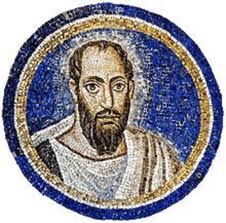
The writings of the Apostle Paul are not ordinary writings. They are not thought-out rhetorical compositions with a logical form, but they are intimate letters, felt, not thought. They call from the innermost depths of one human being to others of his kind,—a call to their innermost depths. But that is not all. With the Apostle Paul this appeal is not an appeal looking merely to the comfort, well-being or salvation of the race. Paul's aim was not the ease of the human race but its proper functioning. Primarily, he had in mind the need of the universe. He thought and spoke of all creation travailing for lack of something,—the scheme of God going awry because we do not perform our function. His call to us, then, is not primarily a call to salvation, but to a post of danger, a post of desperate responsibility. He calls us to be, in his words, "co-workers with God." It is a terrible thing to take this post, not because it is not infinite bliss, but because it means admitting to ourselves the valuelessness of all that we have prided ourselves on, all that we have held dear in this planetary life. Paul uses very emphatic language in this connction. He says, "I count all these things but dung." He says that our function is to die with Christ.
Of course this does not mean asceticism or "giving up" in the ordinary sense, but the shifting of values from the temporal to the eternal, from the phenomenal to the real. In short, Paul's letter to the Romans, which I have selected for special consideration because it contains substantially all his message, is not just a formulation of his beliefs or theological position, but it is a desperate attempt, with all too inadequate words, to put us in direct experiential contact with a living truth which he has experienced.
This truth as I shall try to show, is not merely a thing of words, a formulation, an inert mass, but it is a radio-active organism. It means death or life. "There is no safe dallying with Truth." Either the hearer catches fire,—and it is no mean responsibility to cause that,—or, he encysts, adds just one more layer of verbalization to insulate him forever from reality. "Words are more dangerous than armies. They put the mind to sleep," says Lao Tze. If you wish a quotation nearer home, hear the Quaker Isaac Penington: "Out of words that come from life," he says, "man gathers death."
Paul has been misunderstood. The Epistle to the Romans has been called the Gospel according to St. Paul. If by that phrase it is meant that in this epistle the Apostle Paul has tried to confine in words the truth which Jesus lived, then the phrase is wrong. But this misunderstanding can be corrected. It is worse, however, that Paul has been un-understood. We take his words as intellectual formulations. Many people find them formulations of a particularly trying kind. They never realize that these words were not intended by Paul to have value in themselves. They are with him merely signposts to reality.
The true Gospel of St. Paul is not his written words, but it is to be found in the reality of the experience behind the words. "Ye are my letters," said St. Paul. And if we are not to blind ourselves to the whole purpose of Paul, we must not think that he made that statement idly or rhetorically.
I feel also that there is a special difficulty in presenting the Apostle Paul to Friends or, for that matter, to any who are "socially minded," for the reason that he did not participate, at least in any primary way, in the activities which constitute a large part of our overt behavior. I will not say he had no interest in these activities but he was primarily interested in what he called "a new creation" or a "new creature," rather than in what we may call "social betterment." If there were not this fundamental transformation, or the possibioity of it, then he could not interest himself vitally as a social or economic reformer. He was not an abolitionist. He advised Timothy to take a little wine. He was not a pacifist. He told the soldiers to be good soldiers, and continually represented the Christian life as warfare. At the same time, to appreciate his position, I cannot conceive that the Apostle Paul would have ever taken up the trade of soldiering. Paul was not a feminist. He said that a husband is the head of his wife, and a good many things that feminists will consider worse than that. I might say incidentally on behalf of Paul that I do not feel that he was giving an unworthy view of the relation between man and woman when he could think of no lesser analogy than the relationship between Christ and His Church.
All these are particular instances which occur to the mind; but we can say generally that Paul never engaged actively in any form of social or economic betterment, unless we wish to except his attempt in his younger days to rid society of the cancer of the Christian Church.
In spite, however, of this apparent difference in viewpoint, I venture to proceed, because I feel that Paul was not in principle antagonistic to all these things, or even that he was uninterested. He simply felt that there was something else that came first, without which all of these attempts at betterment were futile. His activities, in view of his experience, were with that primary fundamental something. At worst, he was like the rather unfeeling physician who disregards the patient's discomfort in the intensity of his anxiety to get at the primary cause of the disease. Paul had experienced the desperate essntial need of mankind, and of the universe. No palliative could satisfy him.
Do not misunderstand me. I do not take this position merely, and allow Paul standing by sufferance only. As for myself, I believe that Paul's position is just the same as the Quaker position, in that religion to him, was direct experiential contact with God, beneath and independent of any forms, formulations, beliefs, dogmas, or course of conduct whatsoever. Those things were secondary and had to come out of that underlying experience, if they were to have any meaning at all. But at the same time, that experiential contact, to Paul, was no mere mystical question. It was an active thing. Through contact with the divine love, he became directly and importunately aware of his relationship to all mankind, to that universe of whose groans he tells us so vividly. To Paul, his "blood" relationship to Christ—and by that he means something very intimate and fundamental—necessarily involved the same relationship to the body of Christ. He saw his fellow-man not from any humanitarian standpoint but, to use his expressive phrase, as "the brother for whom Christ dies," that is, as a functioning element in the divine plan. He might not feel it incumbent upon him to attempt to inculcate in that brother what he conceived to be correct ideas as to meat easting, for instance, but if it made that brother to offend, he would eat no meat while the world stood.
Here is a man who is worth investigating. If we are unwilling to call him extraordinary or enigmatic, at least he is not usual. I now purpose to attempt to reach to him through his writings. This is going to take us back first to the Renaissance, and I hope that we can approach the subject in the spirit of impartial inquiry characteristic of that period.
When I think of the Apostle Paul, there arises in my mind, by association, a picture of a skyline. A skyline is a very significant thing. It indicates the line of growth of a city. Just as in a coral reef, it is the outside surface alone that is alive. That is where the little coral animals are pushing forward. The city is pushing ofrward at the skyline, just as the blade of grass pushes through the soil. In the atoll, the city, the blad of grass, the cells of this outside line are pioneers. And so was Paul a pioneer. He had taken upon himself the responsibility of what has been called the "fighting edge" of the universe. As I have said, he was a co-worker with God, But it is not thos implications which cause the picture of the skyline to arise in me when the name of Paul is mentioned.
I think of the skyline of a particular city,—the city of Oxford in England. As the train approaches, the skyline of the buildings of the university makes a very vivid impression. It is so different from any other skyline seen in England. Some of the buildings go back to the times of which I think particularly. In the year 1497, five years after the voyage of Columbus to San Salvador, the University of Oxford was a thriving place. I do not know the number of students in residence at that time, but not much later there were 30,000. This seems rather surprising, but we have to consider that there were not so many seats of learning at that time, and we have to consider that the renaissance of learning was beginning to reach out and take hold of all countries. In this year 1497 there were put up on the buildings of the University of Oxford placards announcing that one of their students, a Master of Arts, but not admitted to holy orders, was about to give a course of lectures on St. Paul's Epistle to the Romans.
The man's name was Colet. He aftewards founded St. Paul's School in London and became Dean of St. Paul's Cathedral. He was a close friend of Erasmus and was, I believe, the one who called Erasmus from Scholasticism in Paris and put him in touch with the new light of the Renaissance. And it was said of Erasmus at the time that he laid the egg of the German Reformation, and Luther only hatched the chicken. It is rather thrilling to me, that the beginning of Colet's activities—the beginning of the beginning, so to speak—was an attempt to apply the new learning of the Renaissance to the letters of the Apostle Paul, and particularly to the Epistle to the Romans.
There is thus a direct connection between the Apostle Paul's letters and the religious freedom which we now enjoy, and perhaps it will give a hint of what I meant1 when I said that Paul's letters were not formulations or verbalizations. It was the truth behind the words, the experience behind the words, which set the fire; it was not the words themselves. It was Paul's words, intellectually considered, to which the old order looked as authority for its dogmas. The thought behind the words detroyed the dogmas. Even to-day extreme sacramentarians look to the words of St. Paul to justify their position, and in fact it is one of the chief charges brought against St. Paul that he actually thus formalized and ecclesiasticized the simple and fundamental truths which Jesus presented. But it is only when his words are intellectually considered, apart from their true meaning, that this mistake can be made. Our purpose here is to penetrate to the inner life behind the words. It was the living experience behind the letters of Paul which destroyed in large measure the formalism which attempted to justify itself by his words.
It was a rather important and significant thing that Colet was delivering these lectures just when he did. For years there had been no lectures on the Scriptures at Oxford. This was undoubtedly because the study of the Scriptures had become a dead thing. In the exegesis of the time the writings were never considered as living wholes, but they were treated textually. That is, the separate texts were given what may be called talismanic significance, and the best interpreter of Scripture was he who was most ingenious in drawing from the words of an isolated text the most numerous and, indeed, the most far-fetched meanings.
The very fact that Colet, who was not a priest, was permitted to lecture upon the Scriptures shows to what a low ebb the interest in the study of the Scriptures had fallen. Colet changed all this. His lectures were different from any that had been heard before and attracted a large attendance. Colet did not attempt to consider the dogmatic meaning of isolated texts. He quoted practically not at all from the scholastic authorities. He adopted the principle in the understanding of Paul's letters which has never been changed to this day, although, of course, we now have much information which was not available to Colet.
This is what Colet says in substance: We have not here a collection of isolated texts, but we have letters,—real letters from a real man to real people. To understand what those letters mean we must know something about the man, we must know something about the people to whom he was writing. With that background then we must take these letters as a whole; and with living letters like those of St. Paul, we cannot, if we have in mind something of the background, fail to reach at least the substance of the truth.
Based on these principles as a foundation for understanding, I now wish to consider some of the sociological influences in the life of Paul, which must be taken into consideration if we are to understand what he means. Paul as he grew up was subjected to a two-fold training and influence, Hebrew or Rabbinical on the one hand, and Greek or classical on the other. When we understand his situation in those two particulars we shall understand many things in his forms of presentation and expression which, if we do not take the conditions into account, really obscure for us his meaning. We must also realize that he was writing to Jews and Greeks who had the Rabbinical training or the classical training, and it was absolutely essential that Paul should write to them in terms and forms which could be apprehended by them in view of the conditioning of their minds.
First of all, Paul was a Hebrew,—"a Hebrew of the Hebrews," he said. He was of the tribe of Benjamin, and bore the name of Saul, the name of the only king who ever came from that tribe.
Here is what Paul says of himself:
Phil 3:5, "As touching the law, a Pharisee."
Gal I:14, "I forged ahead in Judaism beyond many of my own age and race and was more exceedingly zealous for the traditions of my fathers."
Acts 26:5, "According to the strictest sect of our religion, I lived a Pharisee."
When Paul mentions that he was a Pharisee, we want to bear in mind that this was more than a matter of words. To-day the real differences between the various branches of the Protestant Church are very slight. If it is said of a man that he is a Methodist, or a Baptist, we cannot attribute too much significance to the distinction. But with Pharisaism it was different. Here we have to do not with a mere system of doctrine, but with a way of life,—and not only a way of life actively, but also emotionally and intellectually. This was always of the essence of the Jewish religion. It had no theology. It is impossible to systematize the attributes of their God. Instead of a system there was a living personal relation. I cannot think of anything at all comparable in more modern times except the Jesuits, the Society of Jesus. They are profound psychologists. It is not that a child subjected to the Jesuitical training will not depart from the system, but, such is the training that he is absolutely unable to escape from his conditioning. It was something fundamental of this kind that Pharisaism meant. It entered into every fibre of the being.
A part of this influence Paul never got away from. It is very noticeable in the Epistle to the Romans. In spite of his spiritual experience, he kept reverting to an intellectual difficulty due to his early training, which he knew to be an immaterial and meaningless problem, but which intellectually he could not escape.
He knew Christ; he knew Him more than after the flesh. Christ was the only reality in Paul's life. Yet, being convinced from his Pharisaic training that the Jews were God's chosen people, for whom the Messiah was promised, Paul could not intellectually dismiss the question why the Jews rejected Christ if he was indeed the Messiah. It seems to me that this is a very good example indeed of the sort of thing which appears in Paul's letters from time to time and which we must take into account if we are to get the Apostle's real meaning. In other words, in spite of this intellectual difficulty, we should be far afield if our conclusion as to Paul was that he was in doubt whether Christ was really the Messiah.
We also find in the Apostle's letters many instances of analogies and arguments drawn from his Rabbinical training which are meaningless to us, and even strange and disturbing, but, read in the light of the schooling of that day, we can see just what they meant to Paul, and we can understand that they would have a very definite significance to his Jewish readers.
A striking instance occurs in I Cor. 10:4, where, in speaking of the experiences of the Israelites in the Wilderness, Paul says, "They drank of the spiritual rock that followed them"—"went with them" is the right translation. What does that mean? Does anybody know?
It is only in recent years that there has been any understanding of this passage, and the explanation was found in Talmudic interpretation. You will note that in Ex. 17:6 it is recorded that at the beginning of the Wilderness experience Moses struck the rock and the waters gushed forth for the children of Israel. In Num. 20:11, it is recorded that the same incident occurred at the end of the passage through the desert. It is also recorded that in the desert during the journey the Israelites were fed with quail and manna, but it is not recorded where they got their water. The Jewish interpreters were not at a loss. They said that the rock mentioned at the beginning of the Widerness experience and the rock at the end were one and the same rock, and that this rock went along with the children of Israel in all their journeyings. Each night the camp was made about the rock, and channels passing each tent were dug, through which the waters from the rock were carried to all the children of Israel.
Now this story Paul had undoubtedly heard from childhood. I question whether he ever thought of rejecting it. Certainly this intellectual conception has nothing to do with his spiritual experience, and as soon as we know the source of its arising it cannot disturb us or put us off the track in any way. Even if Paul himself did not believe the story, it will readily be seen that to his readers the reference would have immediate meaning, just as one of us might refer to the story of George Washington and the cherry tree.
I will not speak any more about the Hebrew side of Paul's training, but I wanted to give a hint, at least, about it, because the Epistle to the Romans, especially, is full of arguments and illustrations drawn from the Old Testament which had immediate point for Paul's hearers, and which were undoubtedly considered by him to be appropriate material to use for imparting his message. To us the method of argument often seems strange and the illustrations not appropriate nor pointed. We must, therefore, be in a position to recognize these things and allow for them if we are to understand Paul's real message.
Let us now turn to the other side of Paul's world training. I refer to the Greek influence to which he was subjected, as indeed were all the Jews from the time of the dispersion.2 Let us take first his education proper. We are told (Acts 22:3) that he sat at the feet of Gamaliel. This may have some significance. One instance of the broadness of mind of Gamaliel is recorded for us in Acts 5:24–39. When certain of the disciples were being attacked for their Christian propaganda he suggested that they should not be disturbed because, if their work was of God it should not be opposed, and if it was not of God it would come to naught. This, upon analysis, may not prove to be a rule of behaviour of very high order; but at least it shows a breadth of mind sufficient to appreciate that the other man may be right. There is a Jewish record that a Gamaliel taught one thousand students and that half of them studied the Greek classics. It has been assumed that this was the Biblical Gamaliel and that with such a man Paul's education could not have been a narrow one. But modern scholars tell us that the reference is to Gamaliel II, the grandson of Paul's Gamaliel.
However this may be, we find in Paul's writings certain echoes from Greek literature which seem to indicate that he could not have been entirely unacquainted with that literature. Of course he may not have quoted directly, but then in that case these things must have been current in common speech, and if he got them in that indirect way, all the more it is shown how Paul was in touch with Greek life. Perhaps the best known of his quotations is found in the speech on Mars Hill (Acts 17:28), "For we too are his offspring." It has a very good ring in Greek:—Tou gar kai genos esmen.
This line is found in two different philosophical poems, one by Aratus, and one by Cleanthes, both of whom came from the district around Tarsus, where Paul was brought up.3 It is interesting to think that, even if Paul in his Hebrew household, never read Aratus or Cleanthes, nevertheless this line occurred in conversation so that he became familiar with it in the ordinary intercourse of life. We know that he recognised it as a line of poetry, and not merely as a maxim of common speech, because he said concerning it, "As one of your own poets has said."
A second quotation is found in I Cor. 15:33. It is translated, "Evil communications corrupt good manners." This is a part of a line from Menander and has the true swing of the classical hexameter: Phteirousin ethe chresth' homiliai kakai.
He also quotes from Epimenides, in the Epistle to Titus, I:12: "The Cretans are always liars, noxious beasts, idle gluttons" (or "slow bellies" as the Authorized Version used to put it).
Perhaps a more important indication of the fact that Paul was very much at home in the Greek language is his use of the Septuagint. This is the Greek translation of the Old Hebrew Bible, and almost all Paul's quotations from the Old Testament are couched in the language of the Septuagint, rather than being direct quotations from the Hebrew.
But it was not only the Greek language which influenced Paul. There was the even greater influence of the Greek life about him. He said that he was a citizen of no mean city, and he said well. Tarsus does not mean much to us, but it was a very important city in its day. We may perhaps picture this to ourselves best by recalling that through Tarsus flowed the river Cydnos. This was the river where Cleopatra met Antony, and we are all familiar with the pageant of her barge upon the river as pictured by Shakespeare.
Tarsus was also probably the foremost seat of the Stoic philosophy. I have already referred to Paul's quotation from Cleanthes, the Stoic.4 But more important still, we find continually through Paul's Epistles the use of the technical terms of Stoic philosophy and a Stoic point of view which is quite un-Hebrew, and also quite foreign to the ordinary classical methods of thought.
Tarsus, also, we must remember, was a large city, and the Hebrew boy came into close contact with soldiers, slaves, shops, theatres, games and buildings. Many evidences of this appear in the language used by Paul and in the illustrations which he employed. Again and again he couches the Christian struggle in terms of the soldier. The little shops with their oriental chaffering had a great influence upon him. He tells us in one place that we must not "huckster" the word of God. The phenomenon of slavery greatly impressed him. He speaks continually of the branding of slaves, of the emancipation of slaves. In fact a number of times he expresses the new life by saying that we have become slaves of God. Games and sports appear again and again in Paul's letters. Even if Paul, with his Hebrew inheritance, was not particularly impressed with this feature of contemporary Greek life, he knew that his hearers were greatly interested in it, and that in itself was enough to explain his use of words chosen from sporting language and illustrations which make the Christian life analogous to the struggle of the athlete. A very striking example is given in I Cor. 0:24–27. He starts first with a reference to the foot race:
"Do you not know that of all the runners in the race only one receives the prize? Well, then, run so that you can get the prize."
In the next verse he speaks of the training of the athlete. Then he speaks of the fact that the Greeks used to run for a prize of fading laurel, "but we are looking for an incorruptible crown." In the next verse he changes the figure and depicts himself as a boxer bringing his body into condition, "lest" says the Authorized Version, "having preached the gospel, I myself should be a castaway." But what Paul really said, using two technical terms of the arena, was this: "lest, after being a starter, I myself should be disqualified." You can imagine how this appealed to the sporting audience at Corinth.
Another characteristic instance of Paul's use of sporting terms is found at the beginning of the second chapter of the first letter to the Thessalonians. There he speaks of a former "visit" to them when he preached amid great "struggle." The word for "visit" is eisodos. It means literally the "way in," but it is the technical sporting term for entering a race or other athletic contest. And the word for "struggle" is agony, just the word which was used for the straining and struggling of athletics. So Paul presented to his Thessalonian readers a picture of himself entering a wrestling match with them.
Paul as a boy was also greatly interested in the building operations of the city, if we are to judge by the number of times that he refers to building and architects. Every time you find the word "edifying," Paul is really saying "building." The following illustration will perhaps suffice at the present time.
["]In the exercise of the grace given me by God, I, like the competent masterbuilder, have laid a foundation, and others are building upon it. But let every one be careful how he builds. For no one can lay a foundation other than that which is already laid, namely, Jesus Christ. And whether the building which anyone erects on that foundation be of gold or silver or costly stones, or of timber or hay or straw, the character of each individual's work shall appear. For the Day will disclose it, because that Day is to reveal itself in fire, and it is the fire which shall test the quality of every one's work. If the work which any one has erected stands the test, he shall be rewarded. And if any one's work is burnt up, he will suffer loss; he will himself be rescued, but only, as it were, by escaping through the fire." I Cor. 3:10–15.
Thus Paul drew his illustrations from the city life about him—the shops, the slaves, the games, the buildings, just as Jesus drew his from the country life familiar to him and his hearers—the flowers, the birds, the trees, the rain, the wind. These things appear so frequently in Paul's letters because he, like Jesus, was addressing in fact the common people of his time, not, as we often seem to believe, a selected intellectual class. Paul gives a clear indication of the sort of audience he was addressing in I Cor. 1:26–27.
"Not many educated, not many influential, not many of noble birth are called, but God has chosen the foolish things of the world to confound the wise."
To reach such an audience effectively, Paul must be simple and direct. He says (I Cor. 1:17) that he was sent to preach the gospel "not with wisdom of words." In Chap. 2:1, he says, "I came to you, not with superiority of speech or of wisdom, declaring unto you the testimony of God."
With the audience that he had, the theological subtleties of which Paul has been accused would have been simply impossible. And too, we must remember that Paul was so desperately in earnest that he could not have engaged in theologising or philosophising. I am reminded of what John Bunyan said in the preface to "Grace Abounding":
"I could also have stepped into a style much higher than this in which I have here discoursed, and could have adorned all things more than here I have seemed to do, but I dared not. God did not play in tempting of me, neither did I play when I sunk as into a bottomless pit when the pangs of hell got hold upon me. Wherefore, I may not play in relating of this, but be plain and simple and lay down the thing as it was."
That, I contend, is all that Paul did. He tried to express plainly and simply what he had experienced. He says, "We have renounced the hidden things of dishonesty, not dealing in craftiness nor handling the word of God deceitfully, like a petty tradesman, but by clear statement of the truth commending ourselves to every man's conscience in the sight of God." (II Cor. 4:2)
I want to speak now more particularly of the language which Paul used, for a misunderstanding of that language has caused more misapprehension as to the meaning of Paul's letters than any other one thing.
When I began to study the Greek Testament there were about 550 words which were marked in the Lexicon as "biblical" or "ecclesiastical." That is, they were words which were found only in the New Testament and not in Greek secular literature at all. Greek scholars had to guess at their meaning. The theory was that the sacred writers, being directly inspired, felt that the language of ordinary speech was not sufficient or appropriate or, perhaps, holy enough to use, and so they employed certain words not in ordinary usage which had a peculiarly sacred or theological meaning. So in the case of Paul's letters it was considered that he wrote in a peculiarly elevated style to denote the sacred nature of his writings, a sort of ecclesiastical jargon, bearing about the same relation to the Greek of his day that the language of the Authorized Version bears to the language of the ordinary letter writer of to-day. But by what was really an accident, it has been proved that this was not so, but that Paul in his letters really used the language of the common people. So the fact that we find words in Paul's letters which do not occur in secular literature is not due to the employment of an elevated style, but to the use of the vernacular—language so colloquial that it was not found in the classical writing of the day.
The discovery came about in this way: In the time of Paul, the ordinary writing material of the common people was papyrus, strips of papyrus reed, flattened out and pasted together. From time to time from the seventeenth century, documents written upon this papyrus were discovered in Egypt where they had been preserved by the dry climate. Their significance was not recognized and they were kept as curiosities in museums. But finally, in a crocodile cemetery, used as stuffing for the crocodile mummies, enormous quantities of the papyri, as they are called, were found. They were for the most part non-literary documents, manifestly reflecting closely the every day life of the time. They include legal documents such as wills, contracts and receipts; official documents, such as imperial rescripts, judicial reports and petitions; thousands of private letters of every description; business documents, such as accounts, market reports, shop reports, the records of the steward of a farm, of a school, of a large official residence; and miscellaneous items, such as a certificate of membership in a club, a recipe for toothpowder, advice on how to avoid the income tax, and so on.
With this wealth of material available, scholars really began to study the papyri. They compared their language with that of the New Testament, and they found that almost all of those unknown so-called mystical, sacred words were found in these papyri in actual use by the common people for the purpose of ordinary life. They, therefore, came to the inevitable conclusion that the New Testament writings were composed not in a specialized ecclesiastical style, but in the every day language of common life, the language best understood by the people.
Because of this discovery, the writings of the New Testament, and particularly the letters of Paul, have been endued with a new vividness and significance. We are now able for the first time to know just what the language of Paul's letters must have meant to his hearers. They could not possibly have read into those words the theological implications with which we have surrounded them, or with which they have been surrounded for us. They could only have understood the words as they themselves used them in common speech. And this must have been the way that Paul meant them to be understood.
Just to show the character of the material which has been discovered, I want to give an illustration of one of the letters found among the papyri. This is a letter from an Egyptian boy named Theon to his father, also named Theon. Evidently, his father had taken a trip without taking the boy with him, greatly to the boy's displeasure. He writes:
"Theon, to Theon, his father, Greeting: You have done well, indeed. You have not carried me with you to town. If you will not carry me with you to Alexandria I will not write a letter to you, nor speak to you, nor wish you health. If you go to Alexandria without me I will not take hand from you nor greet you again. If you will not carry me, these things come to pass. My mother also said to Archelaus (evidently his slave) 'He drives me mad: away with him!' But you have done well. You have sent me great gifts—locust beans. They deceived us here on the 12th day when you sailed. Finally, I beseech you, send for me. If you do not send I will not eat or drink. Even so. Farewell, I pray."
This is a real schoolboy's letter,—no grammar, no spelling. And this is the sort of thing from which scholars have dug out new meaning for the letters of the Apostle Paul.
A good example of the change of flavor in Paul's letters which the new discoveries have effected, is given in the 4th Chapter of Philippians, beginning with the 15th verse. In this epistle Paul seems to reach the height of his love. It is written in a correspondingly elevated style. At the end, however, Paul begins to speak about money. This seems always to have been a thing about which Paul was a little self-conscious. He wanted to be independent, but the Philippians had given him money, so he here acknowledged it in a jesting way, using many of the technical business terms current at the time. If we read verses 15 to 19 in the Authorized Version, we get no idea of the playful and colloquial nature of what Paul says. The Authorized Version says, verse 15[,] "No church communicated with me as concerning giving and receiving, but ye only." But Paul puts this in a very businesslike way. It mught be translated, "No church but yourselves had any financial dealings with me." These words he uses are "debits" and "credits," two words which are found again and again in the papyri at the head of the accounts of grocers or other small shopkeepers of the time. Then the Authorized Version says, "You sent once and again unto my necessities." Paul really says, "You sent money for my needs." Then he goes on, "It is not the money I am anxious for. What I am anxious for is the interest"—again a technical term—"that accrues"—the banking term. That gives much more of an indication of what Paul said than the authorised translation: "I desire fruit that may abound to your account." Then the Authorized Version says, "For I have all and abound; I am full." Paul really uses the term "paid in full," which appears again and again on receipts that have been found among the papyri. Then the Authorized Version says, "But my God shall supply all your need according to His riches in glory." But the word "supply" is again a colloquial word, "pay." The very language which he employs playfully as between the Philippians and himself, he extends without hesitation to God.
We have thus far been engaged in taking note of some of the sociological circumstances which conditioned Paul's writings and to a certain extent determined their character. We have looked at his Hebrew training, at the Greek life which surrounded him and left its impress upon him, at the character of the people he was addressing, at the language in which he wrote to them. All these things left their marks upon his letters, but they do not explain them, as we shall see.
1 PtS-32 has 'mean'.
2 By 'the dispersion' Mr. Brown refers to the Greek diaspora, particularly as it affected the eastern Mediterranean even before Alexander's conquests. He would not be referring to the Jewish diaspora that began with the destruction of Jerusalem in 70 C.E. since Paul had come to maturity decades earlier.
3 As it happens, Paul's Tarsus lay (and lies) on the southern Mediterranean coast of modern Turkey; the philosopher Cleanthes was from Assos, on the northwestern Mediterranean coast of modern Turkey; the poet Aratus hailed from Soli, on the northern coast of Cyprus.
4 PtS-32 has 'Cleanthes, the stoic'.